Omarchy Mobile: CyanogenMod First, Ecosystem Second
The phone is the last computer you cannot change the software on. You have replaced the operating system on every laptop you have ever owned, and there is a good reason almost nobody does it on a phone: the OS arrives welded to the hardware, the updates land on Google's schedule, and the bootloader is locked against you.
There is one precedent for changing that, and I think Omarchy Mobile is pointed straight at it.
This is a proposal for where Omarchy Mobile should go next.
CyanogenMod already did this once
CyanogenMod, from 2009, let you flash any Android phone with someone else's build of Android. It never became a business. It became something better: a movement. When Cyanogen Inc. shut down in 2016 the community forked it into LineageOS, which today runs on the order of 4.5 million devices, keeps working on hardware Google abandoned years ago, and has now long outlived the company that started the whole thing.
The lesson is not that custom ROMs are a business. It is the shape of how a phone OS gets made: first as software you install onto someone else's hardware, and only later as hardware someone builds for you.
The first half of that shape is already done for Omarchy.
Stage one is already happening
Omarchy Mobile is a community project that runs native Omarchy on a phone: Arch Linux ARM, Hyprland and Omarchy's own packages, on a mainline Linux kernel, with no Android underneath at all. It is MIT licensed, it is not an official Omarchy or Basecamp product, and it is genuinely good work.
The reference device is a Pixel 7 Pro, and 20 of its 22 hardware subsystems work today: display at 120Hz, GPU, touch, Wi-Fi, Bluetooth, cameras, GPS, fingerprint unlock, NFC, charging. The modem and suspend are the last two, and the modem is the long pole — calls will come weeks or months after registration lands.
The safety model is what makes this flashable rather than merely impressive. Omarchy Mobile only ever lives on slot B. Stock Android stays on slot A, so there is always a known-good system to fall back to and a way back to fastboot. Installing erases userdata, but it cannot brick the phone.
There are two other independent ports in flight — one bringing up a OnePlus 7 Pro and a Pixel 7 Pro, one running Omarchy inside a QEMU virtual machine under Termux so it needs no unlock at all, at the price of being slow. The main repo even ships an AGENTS.md written for AI coding agents, because a growing part of bringing up a new phone is a matter of pointing an agent at the device tree.
Stage one, then, is not a proposal. It is a port, with a safety model, and a community. Which leaves the part that is missing.
Stage two: the marketplace
Here is the idea.
CyanogenMod's real legacy was never the ROM. It was the community around it: thousands of people keeping ports alive, answering questions, shipping kernels. LineageOS works because of that, not because of any single tarball.
But Omarchy changes what an "app" even is.
On Omarchy, everything is a package. omarchy update is already the distribution channel, with signed repositories, on the phone as much as on the laptop. A published app could be a pacman package, a Hyprland widget, a shell plugin, a skill for the agent — and the shell is already going that way: Omarchy Mobile asks you to pick your agent at first login, and the widget sheet already carries a button to create a widget with AI.
Which is the opening. If the phone has an agent on it, and the agent can write software, then the interesting artefact is not a shelf of pre-built apps. It is a marketplace where people publish the app they needed, for everyone else — and the phone builds the ones nobody has written yet.
That marketplace does not exist. There is an unofficial directory for desktop Omarchy that indexes 205 packages and installs them with omarchy pkg add; it hosts nothing and sells nothing, it just organises information and points you upstream. For mobile there is nothing at all. The package repository for Omarchy Mobile's own packages is set up, with signing keys, and empty.
The suggestion: fill it. Not with a curated store — that is just a storefront for a fixed catalogue — but with a publish path. Fork the template, omarchy pkg add, or push to your own repository, and the app is on the phone. Then let the agent build and sign one for you on the spot, the way it already builds widgets with AI.
What Cyclon gets right
Cyclon is a Y Combinator F26 company building an AI phone, and it announced itself earlier this week with a $199 refundable deposit toward an estimated $699 phone. Their own hardware is expected in Q2 2027; the first batch ships as a Pixel 8a running Cyclon OS.
Three things about their model are worth copying.
Build your own apps is the wedge, not the assistant. Everyone has a phone assistant now. What changes the game is the phone building the app you were missing — they write the code in a sandbox, test it, fix it, and install it as a real app, and those apps can talk to third-party APIs.
The OS has to work inside the apps you already use, with your accounts. Cyclon delegates across your apps. That is the argument for Android compatibility being central rather than a nice-to-have: for a phone to be useful it has to run the Android apps people already have their data in. On an Omarchy phone, Waydroid stops being a compatibility feature and becomes the product. It is also still the plan rather than the reality — nothing runs on the phone yet.
They designed the hardware and the OS as one thing. Which is stage three, and they are honest that they need a factory for it.
One thing they are also honest about: banking and payment apps, and anything that wants a Google-certified phone, do not work. An Omarchy phone would have the same line, and it is better to say so now than discover it later.
Stage three: a manufacturer
Eventually a manufacturer is needed, because some problems cannot be solved by a community: bootloader unlock, modem certification, Play Integrity, security patches, volume. You cannot ask people to unlock the bootloader of the phone they just bought and then hope they feel safe about it.
Cyclon is running its OS on a Pixel today while it builds the phone. Blue, another YC company, is doing the same shape with its own hardware in development and already sold out its first batch. Software first on someone else's phone, hardware later, is now the standard playbook — and Omarchy's advantage is that it does not need a factory to start.
The proposal, in three stages
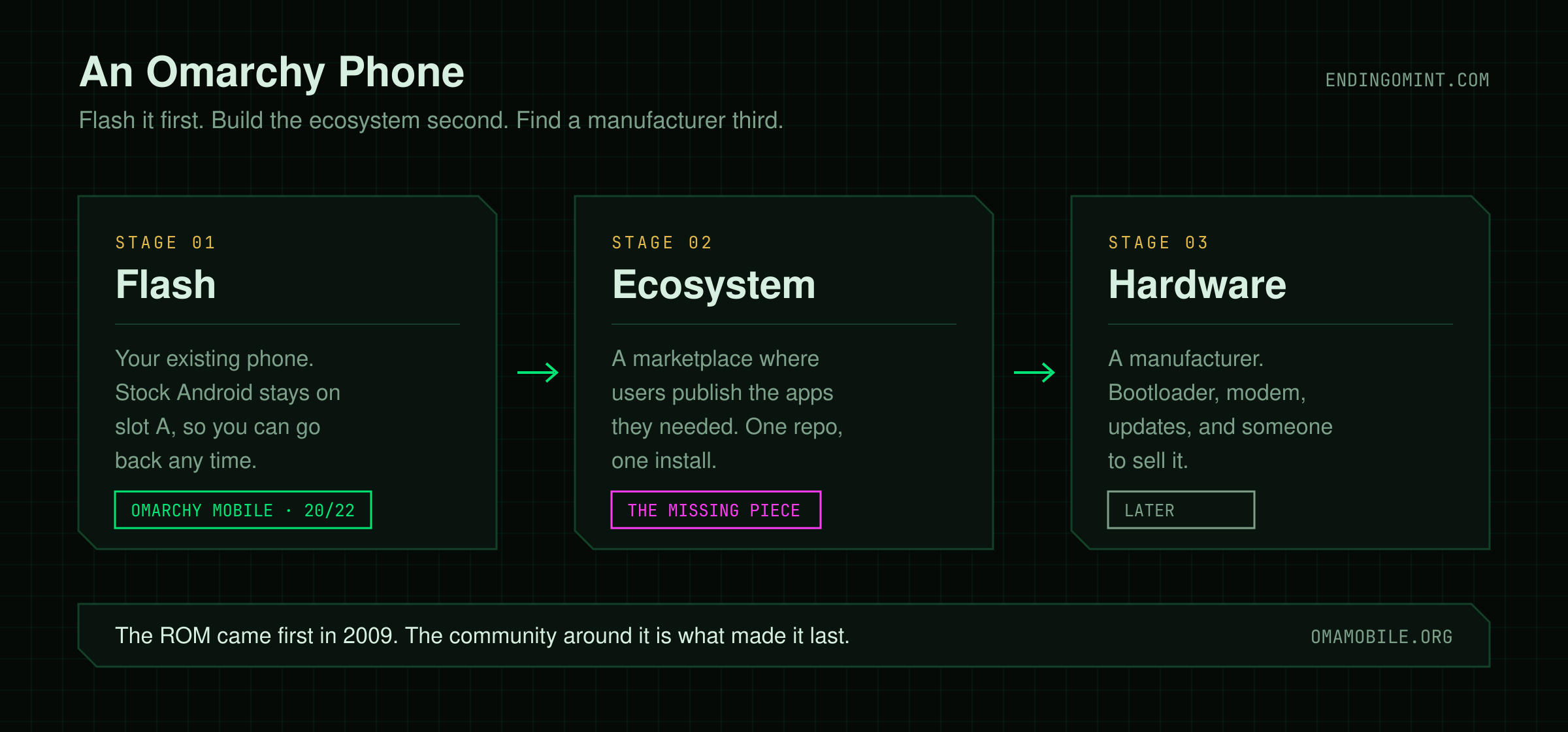
Stage one. Flash existing phones with Omarchy Mobile, and help more ports land. Already happening.
Stage two. A marketplace where people publish apps for each other, on a phone whose agent can build the ones nobody has written yet. The missing piece.
Stage three. Work with a phone manufacturer.
Stage one is being done, competently, by people who love it. Stage three needs a factory and a balance sheet. Stage two needs almost nothing but the willingness to build it — and it is the stage that decides whether an AI-native phone is a nice demo or something people actually carry.
Omarchy has already proved it can be an OS people want to live in. A phone is the same argument, and the port already exists. If you want to take this further, I would happily help build the marketplace part.
~ Mike